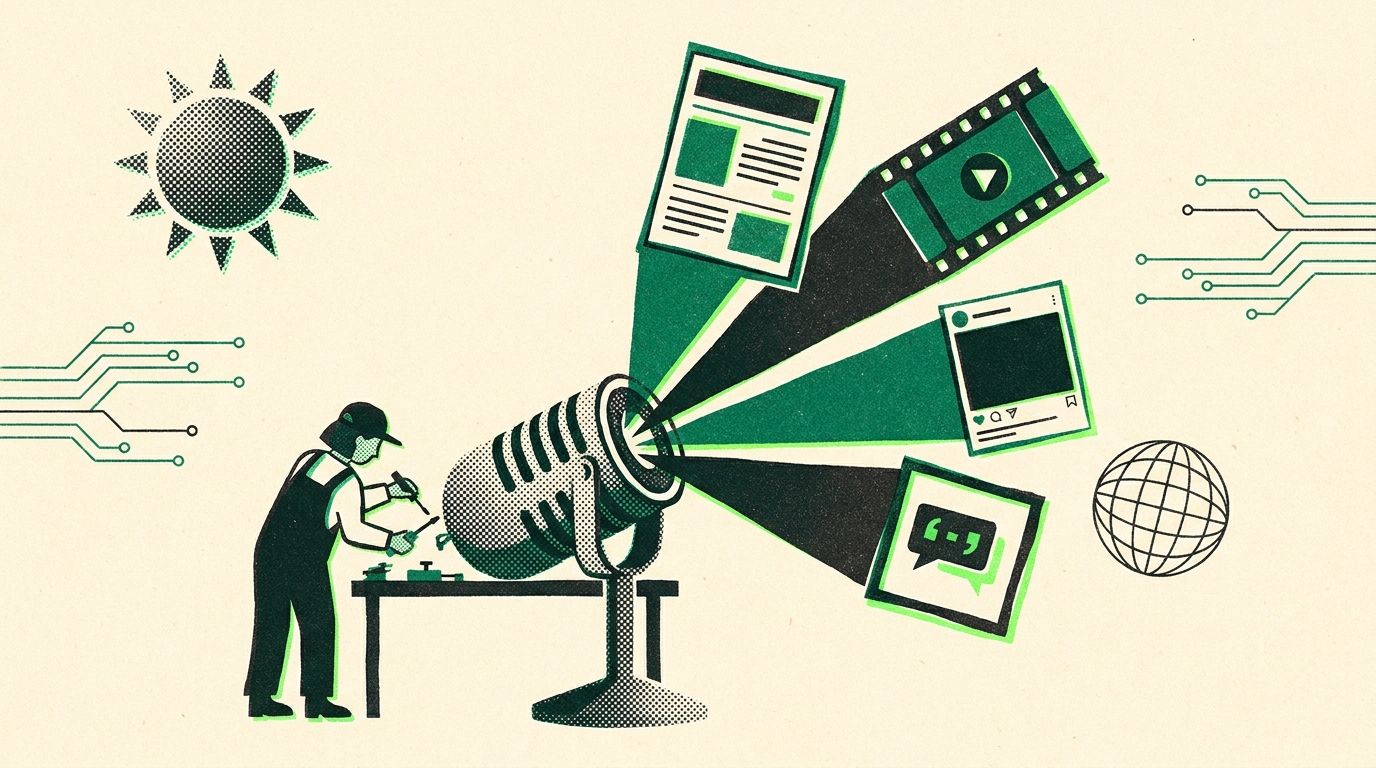
We produce B2B podcasts for a living. Every week, recordings land from our clients (consultants, tech founders, SaaS teams) and we run each one through a repurposing system that turns a single conversation into somewhere between eight and twelve finished pieces of content. The founder shows up, records the episode, and we handle the rest. By the time the episode goes live, clips are already scheduled on LinkedIn, a blog post is in final edits, and a newsletter draft is sitting in the client's inbox.
It is genuinely remarkable how far one podcast stretches. This is the highest-ROI content asset there is. One 45-minute conversation, captured on video, becomes a month of presence across the channels where your buyers actually spend their time. Nothing else compounds the same way. But the system only pays off if you know which assets to make, the order to make them in, and what separates a piece that performs from one that lands flat. That is what this guide walks through: end to end, the same way we run it.
One caveat before we go further. The whole machine requires recording on video. Audio-only podcasts can produce some of these assets, but they shut you out of the highest-reach, highest-engagement formats, which are short video clips on LinkedIn and YouTube Shorts. Still recording audio-only? Read our piece on video podcast vs. audio for B2B first. That upgrade has more leverage than anything else here.
The full output map: what one episode actually becomes
Here's what a single recorded episode produces once the repurposing system is genuinely running. None of this is theoretical. It is the real monthly output spec we deliver across client accounts at AshMedia, running four to eight fully produced episodes per month.
| Asset type | Format | Distribution channel | Monthly volume (4 eps) |
|---|---|---|---|
| Full episode | Audio + video, 30–60 min | Apple Podcasts, Spotify, YouTube | 4 |
| Long-form clips | Video, 5–15 min | YouTube, LinkedIn | 4–8 |
| Short-form clips / Shorts | Vertical video, 30–90 sec | LinkedIn, YouTube Shorts, Instagram Reels | 16–32 |
| SEO blog post | Long-form article, 800–1,500 words | Your website, organic search | 4 |
| Newsletter | Email, 300–500 words | Your email list | 4 |
| Social posts | Text + quote graphic | LinkedIn, X/Twitter | 8–16 |
| Future video scripts | Evergreen topic brief | YouTube, LinkedIn Video | 1–2 per ep identified |
Four episodes a month, conservatively. That is 36 to 62 finished pieces of content out of recording sessions totaling roughly eight hours of conversation. The math rewrites the entire economics of content for a B2B company. You're not producing more content. You're producing it once and distributing it everywhere. That's exactly why our B2B podcast strategy guide frames the podcast as the source that feeds your other content rather than a line item competing with it for budget.
The repurposing workflow
Long-form clips: the art of a complete thought
A long-form clip is not a random ten-minute excerpt. It is a self-contained argument: a moment in the episode where your guest (or you) makes a complete point that stands on its own, no context from the surrounding conversation required. The test is simple. Could someone watch this clip without having heard any other part of the episode and come away with something genuinely useful? If yes, it's a clip. If it leans on setup or callbacks, it isn't.
Good long clips run five to fifteen minutes and center on one of four things: a strong opinion stated clearly, a process or framework explained step by step, a story with a lesson at the end, or a direct answer to a question your buyer asks all the time. The format earns its place on YouTube, where it can rank for search terms independently of the full episode, and on LinkedIn, where the native player rewards watch time. A four-episode month should reliably yield one to two long clips per episode, which adds up to four to eight every month.
Short-form clips & Shorts: hooks, captions, volume
Shorts are the top-of-funnel engine of the whole system. Thirty to ninety seconds, vertical, captioned, built entirely around one punchy moment: a surprising claim, a contrarian take, a one-sentence answer to a question everyone's quietly thinking. The hook has to land in the first two seconds. Not ten, not five. Two. That is the window you get before the thumb keeps scrolling.
Captions are non-negotiable. Depending on the platform and context, as many as 85% of mobile videos get watched without sound, so captioned video holds the viewer who would otherwise scroll past the second it's clear there's no audio playing. Every short we produce carries burned-in captions, styled to the client's brand and timed to the speaker's rhythm.
Volume matters too. Four shorts per episode across four episodes is sixteen a month. Sixteen touchpoints across LinkedIn, YouTube Shorts, and Instagram Reels, enough to hold steady presence in a buyer's feed without any single post needing to perform heroically. The system wins on consistency and volume, not on one viral moment.
The SEO blog post: not a transcript dump
This is the asset most teams get wrong, and it's worth being blunt about why. A transcript dump does not rank. Transcripts are written the way people talk: loosely, with filler, circling back, leaning on assumptions the listener can follow in real time. Google rewards pages that directly and completely answer a specific question a real person would type into a search bar. Those two things are almost never the same document.
The transcript is raw material. The blog post is a separate piece of writing that happens to be sourced from the episode. Treat it that way and it earns traffic. Treat it as a shortcut and it earns nothing.
The right process: pull the episode's core argument or sharpest insight, identify a query a real buyer would actually use (not "episode 47 recap" but something like "how to reduce customer churn in SaaS"), and write a structured article that answers that query with the episode's substance as its backbone. Clear headline, logical structure, prose written to be read rather than a transcript with paragraph breaks added. This article was built exactly that way, drawn from real conversations about how we run podcast repurposing at AshMedia and then restructured around the question you searched to get here. The conversation is the source. This is the deliverable.
Done properly, each blog post earns organic traffic on a long tail of queries your buyers are already asking. That traffic is permanent and it compounds. It also links internally to your other articles and pages, which strengthens the whole site's authority. We break down the full cost picture for this kind of production in our B2B podcast production cost guide.
The newsletter: one insight, a personal note
The newsletter from a podcast episode has exactly one job: take the single best insight and deliver it so the recipient feels like they got something without needing to press play. Shorter is better, three hundred to five hundred words. Lead with the insight. Add a personal note from the host about why it stuck, what it made them rethink, or what they pushed back on in editing. Then link to the full episode and the blog post for anyone who wants more.
The newsletter is your owned-list touchpoint. Unlike LinkedIn or YouTube, you aren't renting reach from an algorithm that can rewrite its rules tomorrow. Every subscriber is a direct line you control. For B2B companies, the newsletter is also the asset most likely to get forwarded to a colleague, which is how a list of a few hundred people, all of them in exactly the right roles, punches well above its size. That forwarding behavior is word-of-mouth with a record in an inbox.
Social posts: pull quotes & contrarian takes
Social posts from an episode fall into two buckets that reliably drive engagement. The first is the pull quote: a single sentence interesting enough to make someone stop, re-read, and share. Not a summary, a quote. "We stopped measuring downloads the day we closed our first deal from a guest referral" is a pull quote. "Episode 12 is live, check it out" is not.
The second bucket is the contrarian take: a claim from the episode that challenges conventional wisdom in your industry. Contrarian content earns comments because people either strongly agree and want to say so, or strongly disagree and really want to say so. Either reaction feeds the algorithm. The one constraint is that the take has to be genuinely held. Manufactured controversy reads as manufactured, and a B2B audience in particular will clock it instantly.
Two to four text posts per episode, each shaped for its platform (longer and story-led on LinkedIn, shorter and sharper on X), gives you eight to sixteen social posts a month with nobody on your team staring at a blank screen. The content is already recorded. The writing is just extraction.
Future video scripts: let energy tell you what to make next
This is the asset most teams never think about, and it's the one that compounds the longest. In every episode there are moments where a guest answers a question and the energy spikes: they lean in, the answer gets more specific, the insight lands hard. Those moments are your roadmap for standalone video content.
The mechanism is straightforward. When a question in an interview consistently produces strong answers across multiple guests, that question is telling you something about what your buyers want to know. Build it into its own standalone video. Not a clip of someone answering it, but your own direct-to-camera take, scripted and produced independently. The episode validated the topic. The standalone video owns the search result for it. It's the same feedback loop the best YouTube channels run, except most of them mine it from comment sections and you find it in your own recordings.
We flag one to two future video script topics per episode as part of our standard repurposing workflow. Over six months that's a roadmap of eight to twelve standalone videos, every one validated by real audience reaction before you write a single word.
Time & effort: DIY vs. with an agency
The honest question behind every repurposing conversation: who does this, and how long does it actually take? Here's a realistic per-episode breakdown, based on what we see from DIY clients before they reach us and what we clock internally.
| Asset | DIY hours (per episode) | With an agency |
|---|---|---|
| Full episode edit (audio + video) | 3–5 hrs | Handled |
| Long-form clips (1–2 clips) | 1–2 hrs | Handled |
| Short-form clips (4–8 shorts) | 2–4 hrs | Handled |
| SEO blog post | 2–4 hrs | Handled |
| Newsletter | 1–2 hrs | Handled or reviewed in 15 min |
| Social posts | 1 hr | Handled |
| Total per episode | 10–18 hrs | ~30 min (your review) |
| Total at 4 eps/mo | 40–72 hrs/mo | ~2 hrs/mo |
For a founder, consultant, or executive billing at any serious rate, 40 to 72 hours a month of production work isn't a content strategy. It's a second job that crowds out the actual one. That's why the build-versus-buy math nearly always lands on outsourcing for B2B firms at the level where a podcast makes sense. Our done-for-you podcast production runs from $3K to $8K per month depending on format, volume, and distribution scope, and for most clients the podcast pays for itself off a single relationship or a shortened sales cycle before month three.
The tools landscape in 2026
We don't push specific tools as hard as we used to. The AI layer has compressed the feature gap between platforms, and a consistent workflow matters far more than which software sits inside it. That said, here's an honest snapshot of what's in active use and what each one is genuinely good at.
Riverside.fm is still the strongest option for remote recording: local-track capture at up to 4K per participant, browser-based, with AI-generated clips and show notes built in. If you're not in the same room as your guest, this is where quality capture starts.
Descript is the production workhorse for text-based editing. You edit the transcript and the audio and video follow. Its "Underlord" AI co-editor handles filler removal, show notes, and multi-step editing instructions from plain-language prompts. If your editor lives in Descript, the workflow is meaningfully faster than timeline-based tools.
Opus Clip is the fastest way to generate short clip candidates from a long video. Paste a URL or upload the file and its AI hands back ten to twenty-five ranked vertical clips, captioned, each with a virality score. It won't replace human judgment on which clips to actually use, but it kills the most time-consuming part of the process: scrubbing a full episode to find the moments worth cutting.
Castmagic earns its place in the content layer. Upload audio or video and it generates show notes, social copy, newsletter drafts, and pull quotes in a single pass. It handles more of the written output in less time than any other single tool we've tested.
None of these tools run the system for you. They accelerate execution inside a workflow that still demands human judgment on what's actually good, what matches the brand voice, and what a specific buyer will find useful. Tools are the engine. Strategy is the steering wheel.
The order of operations that saves time
The most common repurposing mistake isn't making the wrong assets. It's making them in the wrong order and having to redo the work. Here's the sequence that saves the most time across a full episode cycle.
- Transcribe first. Everything downstream (blog post, newsletter, social posts, show notes, clip selection) moves faster once you have a searchable transcript. Do it immediately after recording, not at the end of the workflow.
- Edit the full episode before cutting clips. Clip from the edited version, never the raw recording. Clips pulled from an unedited interview carry the filler, false starts, and dead air you would have cut anyway, and you can't un-publish a clip that went out rough.
- Pull clip candidates before writing the blog post. Watching the episode in clip-selection mode surfaces the strongest moments and the clearest thesis, which makes the blog post faster to outline and write.
- Write the blog post before the newsletter. The newsletter's "one best insight" is easier to spot after the blog post has forced you to structure the episode's whole argument. The newsletter is not a summary of the post. It's the single idea that made the post worth writing.
- Write social posts last. By the time you've edited the episode, selected clips, written the blog post, and drafted the newsletter, you know exactly which lines hit hardest. The pull quotes write themselves.
This sequence also stacks neatly against the production timeline. The full episode edit (step 2) is the longest task and can run in parallel with blog post research (step 3 prep) while the transcript is being cleaned. Hold the order steady across every episode and the system runs on rails: same checklist, same sequence, same delivery window. Inconsistency is how repurposing pipelines break down.
FAQ
How many clips can you really get from one podcast episode?
From a single 40-to-60-minute episode recorded on video, a well-run repurposing workflow typically yields one to two long-form clips (five to fifteen minutes each) and four to eight short-form clips (thirty to ninety seconds each) per episode. At a cadence of four episodes a month, the lower end of our client range, that works out to four to eight long clips and sixteen to thirty-two shorts every month, all from recording sessions you were already planning to do. The quantity scales with episode length and how tightly the conversation stays on-topic. A focused 45-minute interview produces more usable clips than a rambling 90-minute one.
Should the blog post just be the transcript?
No. A transcript dump almost never ranks in search. Transcripts are written the way people talk: loosely structured, full of filler, and organized around the flow of conversation rather than around a search query. Google rewards pages that directly and completely answer a specific question. The right approach is to pull the episode's core argument, restructure it around a keyword a real person would search, and write fresh prose that earns its place on the page. The transcript is raw material, not the deliverable.
Can I repurpose an audio-only podcast?
You can repurpose some assets from an audio-only recording. You can still write a blog post, send a newsletter, and pull quote graphics for text posts. But you lose the highest-distribution, highest-engagement asset class: short video clips. LinkedIn video and YouTube Shorts are where most B2B buyers discover content in their feed, and those formats require video. Audio-only shows produce fewer assets, and the assets they do produce reach a smaller audience. If your podcast isn't recorded on video yet, read our breakdown of video podcast vs. audio for B2B. That's the single highest-leverage production upgrade you can make before anything else in this system fully works.